
Crypto Leverage Trading: How It Works and What It Costs


Reviewed by Ali Nili. Trades crypto and stocks since 2019.
Crypto leverage trading lets traders borrow money to control more prominent positions than they could with their funds. A price move against you costs your margin the same multiple as a move in your favor adds to it.
Traders can choose from different leverage ratios, such as 2x, 5x, or even 100x. This choice allows them to match their risk tolerance and trading goals. The higher the ratio, the closer your liquidation price sits to your entry. This guide works that out at 2x, 5x and 10x on one hypothetical position.
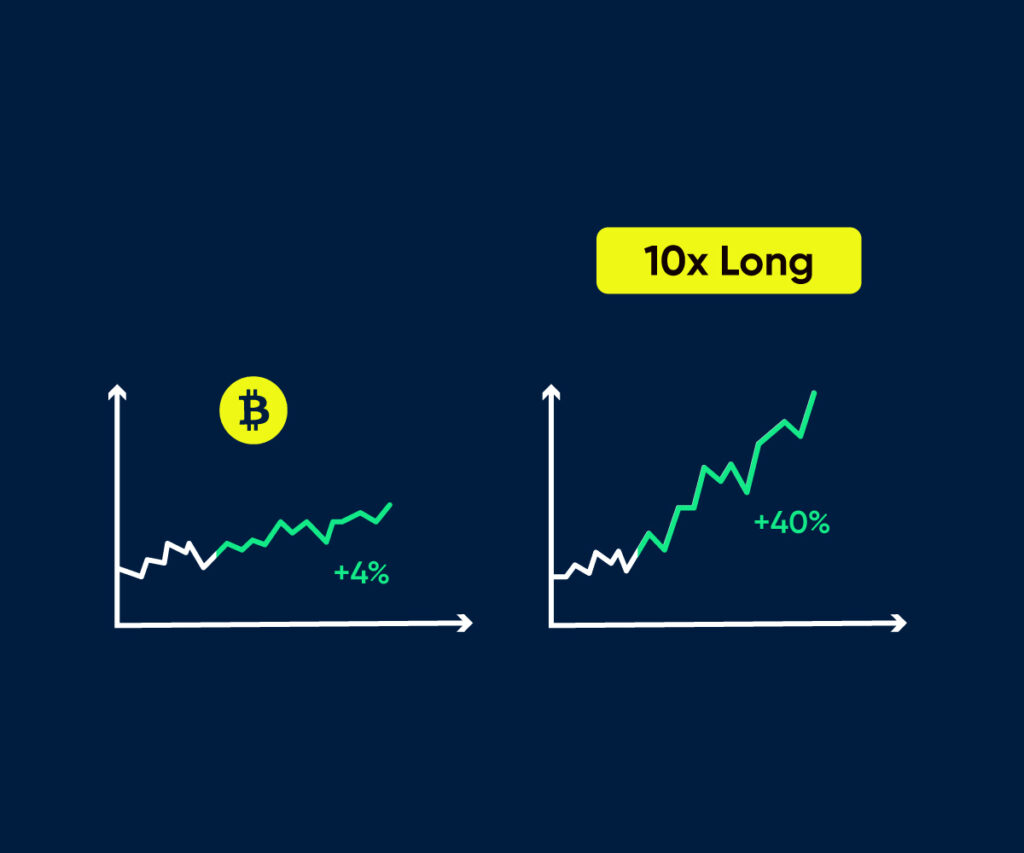
At 20x, a 5% price move equals 100% of the margin you posted, before fees. The sections below work out where that point sits at 2x, 5x and 10x.
Leverage allows traders to trade larger-value contracts while putting down relatively smaller amounts upfront. This gives traders greater capital efficiency and enables them to increase their exposure without additional capital. Gains and losses scale by the same factor.
The short version
- Leverage sets your position value. 1,000 USDT of margin at 10x controls a 10,000 USDT position.
- In the hypothetical example below, a long is liquidated after a 49.75% drop at 2x, a 19.60% drop at 5x and a 9.55% drop at 10x.
- Fees and funding are charged on the position value. A week at 10x costs 3.1% of the margin before the price moves, at 0.01% funding per 8 hours and a 0.05% taker fee.
- Size the position from your stop loss first, then pick the leverage that carries it.
Crypto Leverage Trading Terms, Explained:
These terms come up in every leverage trade, and a few of them sound alike. Take a moment to read and digest the following, and refer back to it if necessary.
- Leverage allows you to use capital from a trading platform to increase your position size without directly borrowing money. This lets you control a larger position with less capital, which raises your exposure to price moves in both directions.
- The Leverage Ratio reflects the proportion of margin to leverage as a ratio. For example, using 10x leverage, with a margin of $1, you can enter a $10 position, hence the leverage ratio of 1:10.
- Position Size refers to the notional amount you buy or sell in a long or short position. Your position size comprises the initial margin plus the additional funds.
- Risk per Trade is the amount or percentage of your trading capital you are prepared to risk on a given trade. It is not the same as position size. You could have a position size with a notional value of $10,000 and only risk 1% or $100 of your account balance. Our position sizing guide covers how to set that number.
- Liquidation is the forced closure of your position by the trading platform, and occurs when your margin drops below your maintenance margin level (your liquidation price). Crypto exchanges trigger it on the mark price and usually reduce the position in stages before closing it (OKX’s liquidation rules describe both steps). On a broker account the same shortfall usually starts with a margin call.
- Equity refers to the total value of a trader’s account, including the initial margin and unrealized profits or losses. When using Cross Margin, the entire equity can be liquidated to cover losses, and trading platforms may close profitable positions to recover necessary funds.
- Margin trading involves borrowing funds from a broker to trade assets, enabling traders to open more prominent positions than their account balance. While related, margin refers to the collateral used, whereas leverage indicates the multiplier effect on position size.
- Margin is the portion of your collateral actively used to open and maintain a leveraged position. Essentially, margin is a fraction of the total position size, backed by the collateral you provide. There are typically two ways that you can choose to allocate collateral.
- Cross-margin usually means your entire balance can be used as collateral (if a platform has a dedicated Derivatives Wallet, it’s usually the whole balance within that wallet). This would result in your liquidation price being further from your entry, but if the liquidation price is reached, you can lose your entire balance.
- Isolated margin uses only a fraction of your collateral, which brings your liquidation price closer to your entry. This option can cap your losses to the specific collateral deployed for the position in question.
- Trading Fee is the cost a trading platform charges whenever you open or close a position. These fees are usually calculated as a small percentage of the total position size (not just your margin), and they apply whether you’re trading spot or derivatives, with or without leverage.
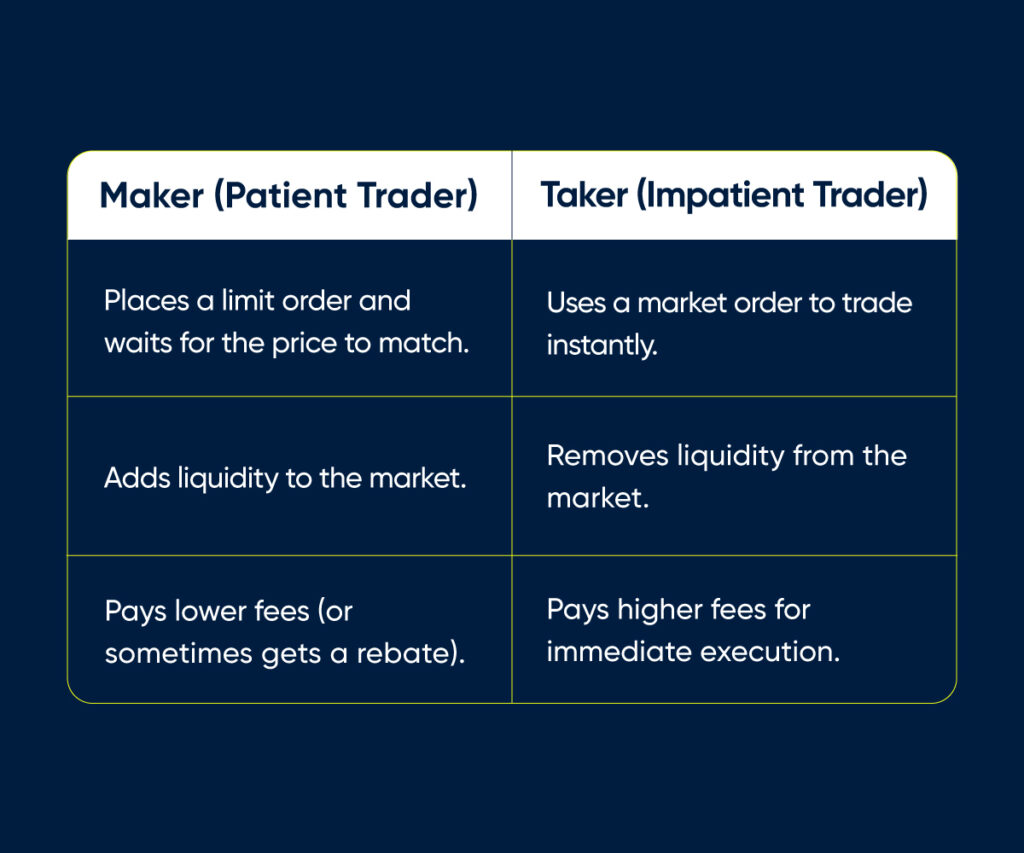
There are generally two trading fees: maker fees and taker fees, based on how your order interacts with the platform’s order book.
Understanding Maker and Taker Fees: A Simple Story
Imagine you’re at a marketplace. In this market, people are either waiting to buy or sell at specific prices (limit orders) or want to buy or sell immediately at the best available price (market orders).
Let’s say you walk into the market and want to buy 1 Bitcoin immediately, no matter the price. You want to get it done.
You shout, “I’ll take the best price right now!”
You’ve just placed a market order, making you a taker.
You’re taking liquidity out of the market: you’re removing someone else’s offer that was already sitting on the order book.
Since you’re using the convenience of speed, the platform charges you a taker fee, which is usually slightly higher. You’re paying a premium to get your trade executed instantly.
Now let’s rewind.
You come back to the same marketplace, but this time you say,
“I want to buy 1 Bitcoin, but only if the price drops to $64,000. I’ll wait.”
You’re placing a limit order. It won’t get filled immediately because the current price might be higher, but it now sits on the order book, waiting for someone to match it.
You’ve become a maker because you’re making liquidity available in the market.
The platform likes this because it helps create a more stable and liquid market. So in return, they reward you by charging a lower fee, called the maker fee. In some cases, they might even pay you a small rebate.
Recap In Plain Words:
- Taker = You want it now. You grab whatever is available → You pay more (taker’s fee)
- Maker = You’re patient. You place an order and wait → You pay less (maker’s fee)
Why Fees Matter in Crypto Leverage Trading
In leverage trading, the size of your trade is often much more significant than your actual capital. So even a slight difference in fees (for example, 0.05% vs. 0.01%) can substantially impact.
Also, remember that fees apply when you enter and exit a trade, so if you’re not paying attention, trading costs can quietly eat into your profits or make your losses worse.
Initial and Maintenance Margin in Futures
There are two main types of margin when trading futures: Initial Margin and Maintenance Margin.
Initial Margin: To start a position on a futures contract, you need to pay an initial margin. This is the amount that the exchange sets for each contract. However, your Futures Commission Merchant (FCM) might ask you to invest extra money above this initial margin.
Maintenance Margin: The maintenance margin is the amount is the amount of money needed in your account at any given time to maintain an open position. If your balance dips below the maintenance margin, your position(s) can be liquidated. Maintenance margins are typically lower than initial margins. However, the exact amount can vary as the exchange sets it.
If the initial margin is the amount of funds you need to open a position, the maintenance margin is the amount of funds you need for your position(s) to remain open. And if your goal is to avoid liquidation, you will want to keep an eye on the value of your account, which can fluctuate with movements in the prices of the futures contracts that you hold, and ensure that it stays above the maintenance margin. When opening a futures position, it is also important to remember that you do not own the underlying asset, and the margin you provide is not a down payment.
Leverage Trading vs. Margin Trading:
The terms margin and leverage are often used interchangeably in finance. While both terms refer to strategies that can amplify an investor’s buying power when trading stocks and other securities, they have some key differences.
- Leverage Trading: Using borrowed funds increases a trader’s exposure to fluctuations in market prices. This lets traders take larger positions than their capital alone would allow, so each price move changes their account by more.
- Margin Trading: Margin trading allows you to use the funds in your trading account as collateral to secure additional capital through borrowing. This practice is the basis for leveraged trading, as the borrowed funds provide the necessary leverage to amplify your trading potential.
In practice, margin is the money you put up and leverage is the ratio between the position and that money.
Key Points
- Leverage is the ratio between your position value and the margin behind it. and increase the amount you can make from it in the future.
- Margin is money moved to your broker’s account to trade with leverage.
- Both raise your exposure, so they raise your losses as much as your gains.
- Though margin and leverage trading look similar, they have some significant differences.
How Crypto Leverage Trading Works: A Worked Example
Here’s one hypothetical position worked through at 2x, 5x and 10x. Every number below comes from a short script with stated inputs, so you can check the arithmetic. None of it is a price forecast or a trade idea.
The setup (hypothetical)
- You post 1,000 USDT of margin on a BTC/USDT perpetual futures contract in isolated margin mode.
- Entry price: 100,000 USDT.
- Maintenance margin rate (MMR): 0.5% of the position value. Exchanges set it by tier, and it rises as the position gets bigger.
- Taker fee: 0.05% of the position value, charged when you open and again when you close.
- Funding rate: 0.01% every 8 hours. That’s the fixed interest-rate part of OKX’s funding formula; the live rate moves with the market and can turn negative.
Leverage sets the position value. 1,000 USDT at 2x controls 2,000 USDT (0.02 BTC), at 5x 5,000 USDT (0.05 BTC) and at 10x 10,000 USDT (0.1 BTC).
Liquidation price at 2x, 5x and 10x
In isolated mode, the exchange closes the position when your margin plus unrealized PnL falls to the maintenance margin. For a long, that price is:
Liquidation price (long) = Entry × (1 – 1/Leverage) ÷ (1 – MMR)
For a short:
Liquidation price (short) = Entry × (1 + 1/Leverage) ÷ (1 + MMR)
| Leverage | Long liquidation (USDT) | Drop to liquidation | Short liquidation (USDT) | Rise to liquidation |
|---|---|---|---|---|
| 2x | 50,251 | 49.75% | 149,254 | 49.25% |
| 5x | 80,402 | 19.60% | 119,403 | 19.40% |
| 10x | 90,452 | 9.55% | 109,453 | 9.45% |

The distance to liquidation is a little under 1 divided by the leverage. At 10x a long survives a 9.55% drop, not a full 10%, because the maintenance margin has to stay in the position. Your exchange’s displayed price will differ slightly: it adds tiered MMR and a liquidation fee, and it uses the mark price.
What a 1% move does to your margin
Each 1% price move changes your margin by 1% times the leverage. At 2x that’s 2% of the margin. At 10x it’s 10%. At 20x, a 5% move equals the whole margin, before fees.
Fees and funding over 7 days
Fees and funding are charged on the position value, not on your margin. The same 1,000 USDT of margin pays 5 times as much at 10x as at 2x.
| Leverage | Taker fees, open and close (USDT) | Funding, 7 days (USDT) | Total (USDT) | Share of the 1,000 USDT margin |
|---|---|---|---|---|
| 2x | 2.00 | 4.20 | 6.20 | 0.62% |
| 5x | 5.00 | 10.50 | 15.50 | 1.55% |
| 10x | 10.00 | 21.00 | 31.00 | 3.10% |
Seven days is 21 funding periods, so a flat 0.01% rate costs 0.21% of the position value. When the rate is positive, longs pay shorts. When it’s negative, shorts pay longs. If funding sat at 0.03% per 8 hours for the whole week (also hypothetical), the 10x position would pay 63 USDT, or 6.3% of the margin.
Funding comes out of the position. In isolated mode that thins the margin and pulls the liquidation price closer: after 7 days of funding at 0.01% with the price unchanged, the 10x long’s liquidation price moves from 90,452 to 90,663 USDT, a 9.34% drop instead of 9.55%.
Size the position first, then pick the leverage
Leverage decides where liquidation sits. Your stop loss and position size decide what a wrong trade costs. Say you risk 1% of a 10,000 USDT account, which is 100 USDT, with a stop 2% below entry. That needs a 5,000 USDT position, whatever leverage carries it. At 5x the position takes 1,000 USDT of margin and the liquidation price sits 19.60% below entry, far past the 2% stop. The risk of ruin calculator shows how the chance of a deep drawdown changes as the size per trade goes up.
Advantages of Crypto Leverage Trading:
- Less capital sits on the exchange. At 10x, 1,000 USDT of margin holds a 10,000 USDT position, and the rest of your account can stay in your own wallet.
- A short is as easy to open as a long. Perpetual futures let you take either side of the same contract.
- A spot holder can hedge. A short perpetual offsets the price moves of BTC you already own, while you pay or receive funding.
Risks of Crypto Leverage Trading:
- Losses scale with the leverage. In the example above a 9.55% drop liquidates a 10x long and the whole 1,000 USDT margin is gone. On cross margin, the loss can draw on the rest of your balance.
- You don’t choose the exit. When the maintenance margin ratio hits the exchange’s trigger, it reduces or closes the position at the mark price and charges a liquidation fee.
- Costs run on the full position value. At 10x, a week of funding at 0.01% per 8 hours plus taker fees to open and close costs 31 USDT, 3.1% of the margin, before the price moves.
FAQ
What is a liquidation price in crypto leverage trading?
It’s the mark price at which your margin plus unrealized PnL falls to the maintenance margin, and the exchange starts reducing or closing your position. On an isolated long it’s about Entry × (1 – 1/Leverage) ÷ (1 – MMR), where MMR is the maintenance margin rate.
How far can the price move before a 10x long is liquidated?
In the hypothetical example in this post (100,000 USDT entry, 0.5% maintenance margin rate, isolated margin), a 10x long is liquidated after a 9.55% drop, at 90,452 USDT. At 5x the distance is 19.60%, and at 2x it’s 49.75%. Your exchange’s figure will differ slightly because of fees and tiered margin rates.
What are funding fees and who pays them?
Funding is a payment between holders of long and short perpetual futures positions, usually every 8 hours. It equals the position value times the funding rate. When the rate is positive, longs pay shorts. When it’s negative, shorts pay longs. At 0.01% per 8 hours, 7 days of funding costs 0.21% of the position value.
What’s the difference between cross and isolated margin?
Isolated margin limits the collateral at risk to the margin you assign to one position, so its liquidation price sits closer to entry. Cross margin uses your whole balance in that account as collateral, so the liquidation price sits further away, but a liquidation can take the whole balance.
Run it on your own trades
Write down the fees and funding of every leveraged position, because the entry and exit prices alone don’t show them. UltraTrader’s crypto trading journal covers crypto futures and can auto-sync your trades from crypto exchanges over a read-only connection.
The example in this post is hypothetical. Results depend on the inputs and assumptions stated above and aren’t a prediction of future performance. This is educational content, not financial advice.